
Lactate gets a bad rep, from decades of misunderstood research. Performance Specialist Will Pastor takes us on a deep dive and tells us why lactate is essential for sports performance…
Around 4 billion years ago, Earth was barren and the atmosphere contained very little oxygen. Life consisted of simple, single-celled organisms which, due to to the low atmospheric oxygen levels, had to develop on an energy system without oxygen. This is what we refer to today as anaerobic respiration, or glycolysis. It is an inefficient process that created a waste product at the end of the reaction: a molecule of lactate. The cell, left with no use for it, excreted it and left it behind. Although not perfect, glycolysis powered life for nearly two billion years.
During these two billion years, oxygen became more abundant, eventually reaching levels close to those we have today in an event known as the Great Oxidation. Some cells developed internal structures that could use this oxygen to produce energy far more efficiently. We call these structures mitochondria, and this marked the birth of aerobic respiration.
Shortly after this, an extremely rare event occurred, so rare that it is suggested that it may have been the great filter for complex life to begin in the first place. One primitive cell engulfed another, and instead of being digested, the two formed a lasting partnership. The absorbed cell became the mitochondrion, providing efficient aerobic energy, while the host cell offered protection and the byproducts of anaerobic respiration. Together they formed the first eukaryotic cell: multiple systems working as one, just as we are today.
Lactate remains a living trace of that ancient world, connecting these two energy pathways. When we exercise intensely, we still rely on glycolysis, but now lactate is no dead end. The mitochondria can use lactate as a fuel for aerobic respiration. What looks like a perfectly engineered athletic system is actually billions of years of layered evolution.
The History of Lactate
Athletes now measure lactate levels in the blood directly when training or testing. Lactate allows us to see the balance between aerobic and anaerobic respiration in real time, defining our training zones and measuring performance. But this was not always the case, lactate once had a bad reputation. For decades, it was blamed for fatigue, cramps, and poor performance, when in truth it is one of the most useful metabolic fuels.
The big misunderstanding of lactate starts not with humans or ancient cells, but with a frog. In the early 1900s, Frederick Hopkins, a very well-named scientist for this endeavour, was experimenting with isolated frog’s leg muscles. He stimulated them to contract in a glass chamber without oxygen. What Hopkins observed was a continuous rise in lactate within the muscle tissue until, at one point, it was no longer able to contract. This simple observation sparked one of the biggest mistakes in exercise science: that lactate causes fatigue and limits exercise, I was still taught this in PE all those years ago.
Universal Fuel
Before we go deeper into metabolism, it’s important to start with the first step: food. Rather than thinking about “burning calories”, it’s more accurate to think of breaking down food into carbohydrates, fats, and protein into smaller molecules that can be used to produce energy. The molecule we produce that acts as our energy currency is called adenosine triphosphate (ATP).
On a molecular level, breaking chemical bonds requires energy, while forming new bonds releases it. ATP releases energy through a reaction called hydrolysis, where it loses a phosphate group and the resulting molecules form more stable bonds than before. This reaction releases the energy our cells rely on for movement, don’t worry too much about this.
Because ATP is small, easy to resynthesise, and highly efficient at transferring energy, it serves as our biological energy currency. Every organism, from the largest animals to the smallest bacteria, depends on this constant cycle of breaking down and rebuilding ATP.
Synthesising ATP
ATP can be produced through three main energy pathways: one aerobic pathway that requires oxygen and two anaerobic pathways that do not. The primary fuels used to generate ATP are fats and carbohydrates, which must first be broken down into free fatty acids and glucose, respectively.
Oxidative phosphorylation:
Uses oxygen inside the mitochondria to produce a large, steady supply of ATP. It is the dominant source of energy during exercise lasting longer than about 75 seconds and powers most biological processes. It can use both fats and glucose.
Glycolysis:
Breaks down glucose to produce ATP at a faster rate than the aerobic system. The anaerobic, high-power end of glycolysis dominates energy production for efforts lasting roughly 20–75 seconds.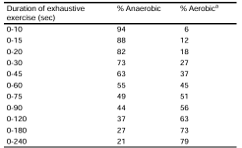
Phosphocreatine (PCr):
Provides an immediate, explosive burst of ATP for 5–10 seconds and is restored during recovery. This powers heavy lifts and quick accelerations used by sprinters and power athletes.
When doing anything physical, oxidative phosphorylation is your engine, creating the bulk of your ATP and running steadily in the background. At low intensities, it predominantly uses fat as its fuel source but swaps to glucose at higher intensities. Oxidative phosphorylation generates the most ATP overall, but it cannot increase output quickly enough to meet sudden changes in demand.
As intensity rises and you need energy faster, this is where glycolysis increases its contribution. The reaction rate can increase over 200 times, providing a rapid supply of energy. Glycolysis can only use glucose as a fuel source. Lastly, the PCr system uses creatine stored in your muscles to generate instantaneous ATP but has a very small supply.
Glycolysis
You now have a basic understanding of the ways we generate ATP, but it is in understanding how these systems interact that things become more interesting, or more complicated, depending on your choice of words.
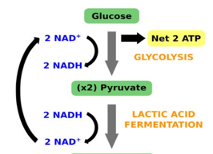
Glycolysis breaks down glucose and is very well named: glyco (glycogen), lysis (splitting). Through a very intricate sequence of steps, you end up producing some ATP and a smaller molecule called pyruvate (we will return to lactate shortly). Glycolysis produces 2 net ATP per glucose, compared to 30–32 net ATP from oxidative phosphorylation. This means it requires more fuel (carbohydrates/glucose) to produce the same amount of energy, making glycolysis much less efficient.
In endurance efforts such as a 10-kilometer run or a 40-minute effort, glycolysis may contribute roughly 10% of total ATP production, with the remaining 90% coming from oxidative phosphorylation (Damasceno et al., 2015). From a performance perspective, glycolysis does not contribute much of the total ATP. So why do we train it, and why does its contribution increase as intensity rises? It is not about producing massive amounts of energy; it is really about providing the fuel for oxidative phosphorylation.
After glycolysis produces ATP, the leftover molecule is pyruvate. Pyruvate is useful because it can be oxidised in the mitochondria to produce more ATP efficiently. The problem is that pyruvate cannot move freely to where it is needed. To solve this, the body converts pyruvate into lactate, a molecule that can travel between cells, muscles, and through the blood.
This concept, known as the lactate shuttle, was discovered by George Brooks and fundamentally changed how we think about lactate and glycolysis. Lactate is not just a by-product or waste. It allows energy produced in one place to be shared with other tissues better suited to use it. In this way, the anaerobic system supports the aerobic system, and both work together to supply energy efficiently.
Linking this back to our single-celled friends four billion years ago, which relied only on the anaerobic system, not requiring oxygen to run. However, it does require a constant supply of glucose and a molecule called NAD⁺. When pyruvate is converted into lactate, NAD⁺ is regenerated in the reaction. This is why those early organisms produced lactate to regenerate NAD⁺ and keep glycolysis running a little longer. Lactate was truly the final waste product.
Now, lactate still supports glycolysis by regenerating NAD⁺, but it can also be transported and used as a fuel. The entire system works together, creating a self-sustained cycle that allows the continued rapid release of energy.
The most profound realisation is that lactate is not a magic molecule that just happens to work perfectly in our metabolism. Lactate has been around far longer than we have. We evolved not just alongside lactate but with it directly in mind. The human body is a complex puzzle designed around lactate as the centre piece.
Anyway…
We’ve covered a lot, from single-celled organisms to frog’s legs and even lactate as an ancient director in the story of life. The key takeaway is this: your body is not running on separate engines competing with one another. It is a fully integrated system. The overwhelming majority of this power comes from your aerobic system. Oxidative phosphorylation is your main supplier of ATP; glycolysis does not replace it, it feeds it. Performance is not about switching one system off and turning another on. It is about how well they work together.
And just like lactate is not a useless waste product, none of this has been a waste of your time. In Part Two, we’ll make this practical. We’ll look at how we actually measure lactate and use it to define training zones, what happens within these zones, and why we prioritise some over others. Understanding these systems means you are no longer training blindly. You can see why certain sessions matter. You can understand why fatigue happens. You can appreciate that improving your mitochondria, your lactate clearance, and your aerobic capacity is what truly raises your ceiling.